Optical burst switching (OBS) has become one of the best and widely used optical networking techniques. It offers more efficient bandwidth usage than optical packet switching (OPS) and optical circuit switching (OCS).However, it undergoes more attacks than other techniques and the Classical security approach cannot solve its security problem. Therefore, a new security approach based on machine learning and cloud computing is proposed in this article. We used the Google Colab platform to apply Support Vector Machine (SVM) and Extreme Learning Machine (ELM)to Burst Header Packet (BHP) flooding attack on Optical Burst Switching (OBS) Network Data Set.
Industry 4.0 is a tsunami that will invade the whole world. The real challenge of the future factories requires a high degree of reliability both in machinery and equipment. Thereupon, shifting the rudder towards new trends is an inevitable obligation in this fourth industrial revolution where the maintenance system has radically changed to a new one called predictive maintenance 4.0 (PdM 4.0). This latter is used to avoid predicted problems of machines and increase their lifespan taking into account that if machines have not any predicted problem, they will never be checked. However, in order to get successful prediction of any kind of problems, minimizing energy and resources consumption along with saving costs, this PdM 4.0 needs many new emerging technologies such as the internet of things infrastructure, collection and distribution of data from different smart sensors, analyzing/interpreting a huge amount of data using machine/deep learning…etc. This paper is devoted to present the industry 4.0 and its specific technologies used to ameliorate the existing predictive maintenance strategy. An example is given via a web platform to get a clear idea of how PdM 4.0 is applied in smart factories.
Industry 4.0 is a tsunami that will invade the whole world. The real challenge of the future factories requires a high degree of reliability both in machinery and equipment. Thereupon, shifting the rudder towards new trends is an inevitable obligation in this fourth industrial revolution where the maintenance system has radically changed to a new one called predictive maintenance 4.0 (PdM 4.0). This latter is used to avoid predicted problems of machines and increase their lifespan taking into account that if machines have not any predicted problem, they will never be checked. However, in order to get successful prediction of any kind of problems, minimizing energy and resources consumption along with saving costs, this PdM 4.0 needs many new emerging technologies such as the internet of things infrastructure, collection and distribution of data from different smart sensors, analyzing/interpreting a huge amount of data using machine/deep learning…etc. This paper is devoted to present the industry 4.0 and its specific technologies used to ameliorate the existing predictive maintenance strategy. An example is given via a web platform to get a clear idea of how PdM 4.0 is applied in smart factories.
In this paper, our objective is dedicated to the detection of a deterioration in the estimated operating time by giving preventive action before a failure, and the classification of breakdowns after failure by giving the action of the diagnosis and / or maintenance. For this reason, we propose a new Neuro-fuzzy assistance prognosis system based on pattern recognition called "NFPROG" (Neuro Fuzzy Prognosis). NFPROG is an interactive simulation software, developed within the Laboratory of Automation and Production (LAP) -University of Batna, Algeria. It is a four-layer fuzzy preceptor whose architecture is based on Elman neural networks. This system is applied to the cement manufacturing process (cooking process) to the cement manufacturing company of Ain-Touta-Batna, Algeria. And since this company has an installation and configuration S7-400 of Siemens PLC PCS7was chosen as a programming language platform for our system.
Le Groupe Sonatrach est le géant algérien de l’industrie pétro-gazière. Sa force réside dans sa capacité à être un Groupe intégré dans l’ensemble de la chaîne de valeurs (depuis l’exploration en passant par la production jusqu’à la commercialisation). Ses installations onshore, qui sont considérées comme des systèmes sociotechniques complexes, souffrent des problèmes de vieillissement matérialisés par la dégradation des performances de ces installations. Cette thèse de doctorat a pour objet d’étudier ce problème de vieillissement dans le but de le maîtriser. S’intégrant dans ce contexte et après avoir rappelé le phénomène du vieillissement ainsi que les approches qui le gouverne, une proposition d’une approche de maîrise du vieillissement à base d’indicateurs est proposée dans un premier temps et dans un second temps une étude critique du référentiel "Gestion des Modifications" du Groupe Sonatrach est également présentée.
Introduction: Diabetic nephropathy (DN) is an insidious disease and is the leading cause of renal failure in diabetic patients. The main objective of this study was the early diagnosis of DN in at-risk individuals, using urinary albumin excretion to establish associations between glycemic balance, dyslipidemia, and renal involvement.
Methods: This prospective study included 292 patients with type 1 and 2 diabetes (T1D and T2D). Microalbuminuria was assessed using urinary microalbumin and creatinine ratios, assessed from the same first-morning urine sample. A glycated hemoglobin (EHbA1c) assay and lipid balance were also performed.
Results: The cohort had an average age of 55±15.9 years and a sex ratio of 0.67. Of the 292 patients, 35.3% were positive for microalbuminuria. A linear regression model showed a strong correlation between microalbuminuria and glycemic imbalance, total cholesterol, triglyceride, low-density lipoprotein (LDL-cholesterol), systolic blood pressure (SBP), and blood pressure diastolic (DBP), however, the chi-square test (X2) showed a negative association with the absence of microvascular complications (retinopathy and neuropathy) in type 1 diabetics. In type 2 diabetics, the linear regression model showed a positive relationship between microalbuminuria and EHbA1c, SBP, DBP, body mass index (BMI), abdominal perimeter, and lipid balance. While the chi-square (X2) test showed strong links between microvascular complications, smoking, alcohol consumption, high blood pressure (BP), and microalbuminuria, more detailed logistic regression analyses revealed associations between microalbuminuria and poorly balanced EHbA1c, systolic blood pressure (SBP), and disturbances in the balance sheet of HDL-cholesterol only.
Conclusions: DN appeared to be strongly correlated with poor glycemic control and disturbances in lipid profiles, suggesting dietary and improved medical control are important parameters for this condition.
The common used goodeness-of-fit tests are based on the empirical distributions functions (EDF) where distances between empirical and theoretical hypothesized distributions are compared to critical values. The aim of this paper is to provide for different sample sizes, tables of goodness-of-fit critical values of modified Kolmogorov-Smirnov statistic Dn,��, Anderson-Darling statistic A2, Cramer-Von Mises statistic W2,�2, Liao and Shimokawa statistic Ln, and Watson statistic U2 for the competing risks model of Bertholon which is used to describe the reliability of real systems where failure times can have different risks and in medical studies to characterize the survival time of patients who can have risks of death from different causes. The power of these statistics is studied using some alternatives such as the exponential, the inverse Weibull, the exponentiated Weibull and the exponentiated exponential distributions. All the computation are carried out by using matlab software and Monte Carlo method.
This article is devoted to the study of the performance of the double star cage asynchronous generator (GASDE) in isolated site. The control system consists of a GASDE connected to a dc bus and a load at the output of two PWM control rectifiers. A comparative study between the conventional control technique and the adapted control based on the introduction of the SVM- PI-fuzzy and a new flux estimator (virtual stator flux) in order to improve the quality of energy and to attenuate the harmonic of the current.
Association rules are the specific data mining methods aiming to discover explicit relations between the different attributes in a large dataset. However, in reality, several datasets may contain both numeric and categorical attributes. Recently, many meta-heuristic algorithms that mimic the nature are developed for solving continuous problems. This article proposes a new algorithm, DCSA-QAR, for mining quantitative association rules based on crow search algorithm (CSA). To accomplish this, new operators are defined to increase the ability to explore the searching space and ensure the transition from the continuous to the discrete version of CSA. Moreover, a new discretization algorithm is adopted for numerical attributes taking into account dependencies probably that exist between attributes. Finally, to evaluate the performance, DCSA-QAR is compared with particle swarm optimization and mono and multi-objective evolutionary approaches for mining association rules. The results obtained over real-world datasets show the outstanding performance of DCSA-QAR in terms of quality measures.
This paper presents a teaching-learning-based optimization algorithm for discrete large-scale multi-objective problems (DLM-TLBO). Unlike the previous variants, the learning strategy used by each individual and the acquired knowledge are defined based on its level. The proposed approach is used to solve a bi-objective object clustering task (B-OCT) in a swarm robotic system, as a case study. The simple robots have as mission the gathering of a number of objects distributed randomly, while respecting two objectives: maximizing the clustering quality, and minimizing the energy consumed by these robots. The simulation results of the proposed algorithm are compared to those obtained by the well-known algorithm NSGA-II. The results show the superiority of the proposed DLM-TLBO in terms of the quality of the obtained Pareto front approximation and convergence speed.
This study aims to assess the diversity and distribution of fungal mycoflora developing on Cedrus atlantica (Endl) G. Manetti ex Carrière needles in three sites in the Belezma National Park (Biosphere Reserve, Northeast - Algeria). Three sites were sampled according to a cedar decline gradient, these are the massifs of: Telmet (healthy site), Boumerzoug (moderately depressed) and Tougurt (decayed site). Polymerase chain reaction (PCR) molecular analysis, allows identifying 19 endophytic mycotaxa. All the identified species have a weak occurrence frequency (less than 25%). In terms of specific richness, the moderately depressed site (Boumerzoug) homes the largest number of taxa (S = 17), followed by healthy site of Telmet (12 taxa), while the depressed site of Tougurt was the least populated (8 taxa). The hierarchical classification analysis (HCA) showed that the taxonomic composition of endophyte associations differs clearly from one site to another according to the cedar decline. The clustering representing healthy massif brings 2 species which are demanding phytoparasitic endophytes (Fusarium sp. and Xylaria sp.). The group associated to moderately depressed site hosts 7 taxa with a wide ecological valence, such as: Canariomyces notabilis, Canariomyces vonarxii, Chaetomium aegilopis, Coniolariella hispanica and Penicillium kubanicum. Then, mycoflora group noted in the decayed cedar includes 10 taxa, in particular, saprophytic mycotaxa relatively less demanding with a high ecological valence like: Biscogniauxia mediterranea, Alternaria arborescens, A. tenuissima and three species of Chaetomium genus. The mycotaxa distribution is related to the specific conditions of colonized trees. Taxa specific to healthy and decayed massifs would represent bio indicators of the phytosanitary and ecological conditions of colonized cedars.
The direct control power (DPC) of the of the double feed induction generator (DFIG) using conventional controllers based on PI regulators is characterized by poor results: Robustness properties are not guaranteed in the face of parametric uncertainties and strong ripple of the powers. From the best evoked control techniques presented in this field to overcome these drawbacks, we will study some improvement variants such as the use of The second order sliding mode control (SOSMC) developed on the basis of the super twisting torsion algorithm (STA) associated with the fuzzy logic control to obtain (FSOSMC) in order to obtain acceptable performance. Finally, the effectiveness of the planned control system is studied using Matlab/Simulink. The proposed method that not only reduces power ripples, but also improves driving dynamics by making it less sensitive to parameter uncertainty.
On one hand, there are many proposed intrusion detection systems (IDSs) in the literature. On the other hand, many studies try to deduce the important features that can best detect attacks. This paper presents a new and an easy-to-implement approach to intrusion detection, named distance sum-based k-nearest neighbors (DS-kNN), which is an improved version of k-NN classifier. Given a data sample to classify, DS-kNN computes the distance sum of the k-nearest neighbors of the data sample in each of the possible classes of the dataset. Then, the data sample is assigned to the class having the smallest sum. The experimental results show that the DS-kNN classifier performs better than the original k-NN algorithm in terms of accuracy, detection rate, false positive, and attacks classification. The authors mainly compare DS-kNN to CANN, but also to SVM, S-NDAE, and DBN. The obtained results also show that the approach is very competitive.
In this paper, we propose an implementation of a new technique of power maximization using a photovoltaic system emulator. The PV system design and its performance evaluation test before installation would be both costly and time-consuming. To overcome this problem the use of an emulator adds more performance and efficiency in the laboratory. Also, by measuring the voltage and current from the PV emulator the characteristic I-V and P-V are extract.The need to consider the measure power state is strongly nonlinear distribution curve with noise. For that reason, to establish and to detect the power value, measurement equations and dynamic equations proposed MPPT control strategy based on Kalman filter algorithm. The correctness and effectiveness of the strategy is verified by simulation and experiment. This algorithm was experimentally implemented. Data acquisition and control system were implemented using dSPACE1103. The results show that the Kalman filter MPPT work accurately and successfully under the change of solar irradiation.
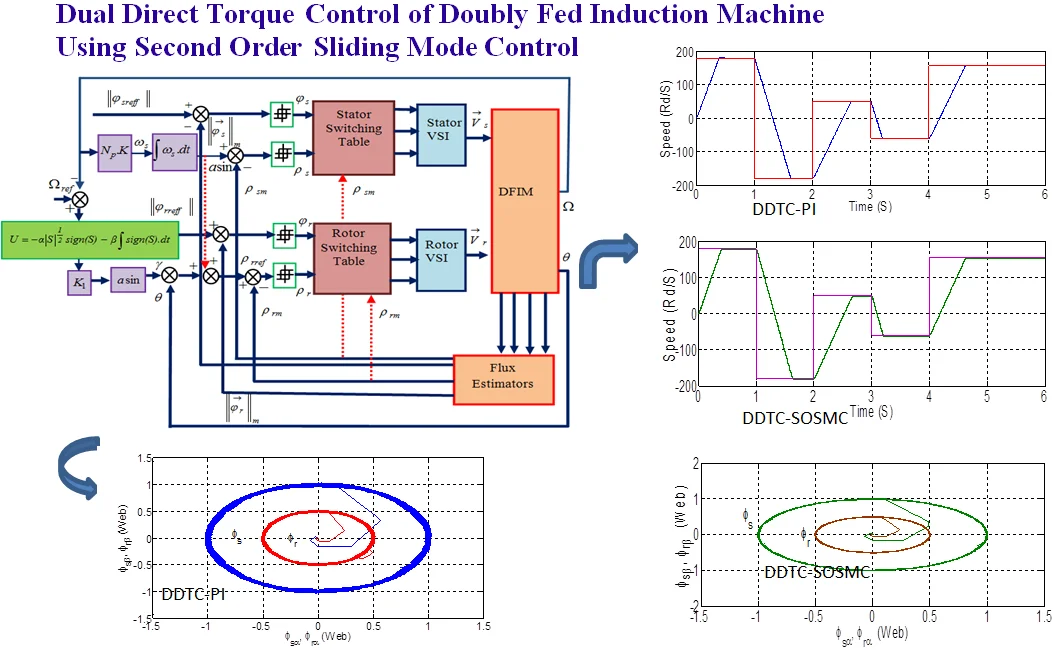
In this paper a dual direct torque control (DDTC) strategy with second-order sliding mode control (SOSMC) controller of the doubly fed Induction motor (DFIM) is presented in order to overcome some drawback such as ripples in torque, flux and to improve dual direct torque control (DDTC) performance toward the electrical parameters variations. This control strategy used in the doubly fed induction machine supplied, coupled by two voltage source inverters in rotor and stator sides witches are linked to two switching tables in order to determined the rotor and stator flux vector control. This controller based on super-twisting algorithm (STA). Comparative results between a classical controller (PI) and the proposed controller can prove the very satisfactory performance and robustness of this new controller.
In this paper a dual direct torque control (DDTC) strategy with second-order sliding mode control (SOSMC) controller of the doubly fed Induction motor (DFIM) is presented in order to overcome some drawback such as ripples in torque, flux and to improve dual direct torque control (DDTC) performance toward the electrical parameters variations. This control strategy used in the doubly fed induction machine supplied, coupled by two voltage source inverters in rotor and stator sides witches are linked to two switching tables in order to determined the rotor and stator flux vector control. This controller based on super-twisting algorithm (STA). Comparative results between a classical controller (PI) and the proposed controller can prove the very satisfactory performance and robustness of this new controller.
Benfriha A-I, Triqui-Sari L, Bougloula A-E, Bennekrouf M. Dynamic planning design of three level distribution network with horizontal and vertical exchange. Inventory management in distribution networks remains a challenging task due to the demand nature and the limited storage capacity. In this work, we study a three-level, a multi-product and a multi-period distribution network consisting of a central ware. 2021.Abstract
Inventory management in distribution networks remains a challenging task due to the demand nature and the limited storage capacity. In this work, we study a three-level, a multi-product and a multi-period distribution network consisting of a central warehouse, three distribution centres and six wholesalers. Each of them faces a random demand. In order to optimise the inventory management in the distribution network, we first propose to make a horizontal cooperation between actors of the same level in the form of product exchange; then we propose a second approach based on vertical-horizontal cooperation. Both approaches are modelled as a MIP model and solved using the CPLEX solver. The objective of this study is to analyse the performance in terms of costs, quantities in stock and customer satisfaction.
In this paper, we have carried out an experimental study of the detection of top rail surface cracks. Firstly, we have highlighted the inability to inspect the entire rail head surface by a single sensor with a single scan. To overcome this inspection inability, we have proposed a multisensor system composed of three differential probes arranged within a specific configuration. The yielded results showed the efficiency and the robustness of the proposed configuration in the detection of cracks regardless its size, orientation and location.